
Compressed-air calculator
Sizing compressed-air piping
Too small a diameter imposes a permanent pressure loss; too large a diameter costs more than it should. The right diameter is chosen on two criteria: allowable pressure loss and flow velocity.
This calculator recommends a diameter for your flow and topology — dead-end or loop network — and shows the effect of each candidate diameter.
Pipe sizing
Recommended pipe diameter by pressure drop and velocity (open/closed loop).
Open line or loop — where is the length measured?
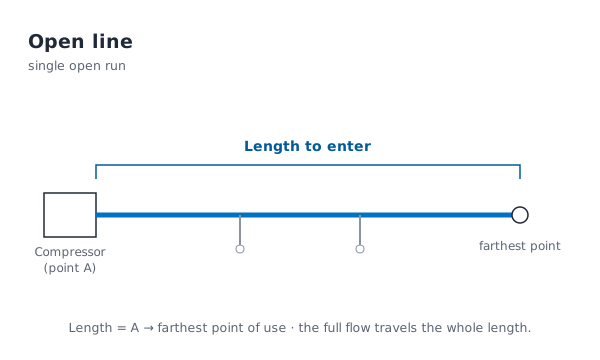

Enter the real pipe length. Open line: full Q and L. Loop (CAGI ½): air travels at most ½ the length → the tool computes over ½ length (drop ≈ half) at full flow, hence a smaller diameter than an open line.
Recommended diameter
To calculate, still needed: the demand flow, the total length.
⚠ No chart diameter meets the limits — the largest is shown. Contact Onyx M3.
Smallest chart diameter that meets both the max pressure drop and 35 ft/s.
Closed loop (CAGI ½ rule): air travels at most half the length → pressure drop reduced by about one-half (CAGI ch.4); full flow (CAGI sets no “Q/2”), so velocity at full flow (upper bound). Velocity red if > 35 ft/s; ΔP red if above the limit.
Detail by criterion (under / optimal / over)
Open loop — pressure drop
| Pipe | Velocity | ΔP | |
|---|---|---|---|
| Under | — | — | — |
| Optimal | — | — | — |
| Over | — | — | — |
Open loop — velocity (≤ 35 ft/s)
| Pipe | Velocity | ΔP | |
|---|---|---|---|
| Under | — | — | — |
| Optimal | — | — | — |
| Over | — | — | — |
Closed loop — pressure drop
| Pipe | Velocity | ΔP | |
|---|---|---|---|
| Under | — | — | — |
| Optimal | — | — | — |
| Over | — | — | — |
Closed loop — velocity (≤ 35 ft/s)
| Pipe | Velocity | ΔP | |
|---|---|---|---|
| Under | — | — | — |
| Optimal | — | — | — |
| Over | — | — | — |
Indicative estimates — validate all results before any technical decision.